![[personal profile]](https://www.dreamwidth.org/img/silk/identity/user.png) nicholas_lucien
nicholas_lucienTo help with all this I used many sources for information to include: sites that sell vintage Cadillacs (like eBay), personal websites detailing the owners taking apart certain components, restoration sites that supply refurbished or new replacements of Cadillac parts, YouTube for videos of cars being worked on or running or whatever, databases compiling raw info like number of cars made, and Wikipedia. Many books and pamphlets were utilized like Assouline’s Cadillac, Hendry’s Cadillac: The Complete History, Headrick Jr’s Cadillac: The Tailfin Years, the 1961 Cadillac Shop Manual, the 1961 Convertible Top Manual, the 1959 -1967 Cadillac Owner’s Manuals, the 1961 Cadillac Accessories pamphlet, the 1961 Cadillac Flat Rate Schedule, the 1961 Cadillac Data Book, the 1961 Cadillac Color Chip Chart, the GM Heritage Center, the info online when Jolliffe was selling the 1961 Cadillac, and Forever Knight episodes. In addition, actual pieces were acquired, dismantled, and photographed, and can be found here on Flickr. Fonts used in some images is the immajer-FK font. And as always, feel free to use anything you like!
Cadillac – THE Standard of the World
The story begins with Le Sieur Antoine de la Mothe Cadillac. Working as a surveyor in the early 1700s in French North America, he was there to find a site for a permanent settlement and trading post under the authority of Louis XIV. He would find one and named it Ville d’Etroit (the village of the straights), what we call Detroit.
Over one hundred and fifty years later, Henry M Leland was born. He was very mechanically inclined and worked in many places perfecting his skills and (from various companies like rifle makers and sewing machine makers) he learned to create pieces with interchangeable parts and precision standards. By 1890 Leland was in Detroit in his company he co-owned making tools (like gears) and machines and by 1896 they were building steam engines and boat engines. 1896 saw the beginnings of Olds Gasoline Engine works, but they had a problem with their materials and the process to build the engines was slow. Leland’s company would help, creating a quiet engine with gears that were precision ground and interchangeable from car to car (which no one else was doing). When put to the test during an automobile show, comparing their engine to the engines made by Dodge, Henry Ford would remark that the engines seemed to be performing equally, but that the Leland engine had a brake on it, slowing it down. Once the brake was removed, Leland’s engine greatly outperformed the other and had less friction. This got Leland thinking about moving into the auto industry. He built a better engine for Olds (3 times better than anyone else’s), but the extra cost and time of making a larger and stronger car to handle this bigger and more powerful engine meant Olds was not interested in it. A year later (1902) Leland was approached by two men who were liquidating the Detroit Automotive Company (also called the Henry Ford Company); the men’s chief engineer, Henry Ford, had recommended they seek out Leland as Ford was moving on to start another company. Instead of selling the machinery and building off, Leland suggested to continue making cars and use his engines. So just after Detroit celebrated its 200th anniversary of its founding by Cadillac, the name for the new company was chosen to be Cadillac. On 7 Aug 1906, the trademark of the Cadillac crest was granted for the company.
Early designs for cars were very similar across all car manufacturers in the beginning: they looked like the open buggies of the time, just with an engine instead of a horse. Cadillac would distinguish itself with their precision-cut pieces that were interchangable across all the cars, so replacements of just the malfunctioned piece could be done and not have to replace the entire unit (and as long as the customer had some basic car knowledge, they could replace the part themselves). Specially-designed pieces would be used in the manufacture of the Cadillac cars; those pieces were patented, thus giving these cars an additional something no other car had. Not that these cars would still be free from problems – the engine was still too powerful so that would put stress and strain on the chassis. Soon orders were piling up as the chassis machine shop (not run by Leland) couldn’t keep up with both the creation and fixing of customer’s cars. Leland sent his engineers to take over and create a new chassis that could handle the engine. Deciding to integrate and control all aspects of the car manufacture and not rely on another company for any parts and supplies, everything was brought together and the Cadillac Motor Company was created in 1905.
Early on, Cadillac was impressing people. 1903 in England, Frederick S Bennett was reading an automotive trade journal and came across an ad for Cadillac. Liking the look (and the arrogant sales pitch) he convinced the owners of the company he worked for, the Anglo-American Motor Company, to purchase a Cadillac to enter it into a number of grueling automotive tests/sporting events. As soon as the Cadillac arrived, it was immediately entered into a hill climb (where loaded cars had to drive up a steep hill). The English, not overly fond of non-English things, were impressed as the Cadillac easily made the climb while other cars, well, did not always make it. The same car was entered into more climb competitions and into the famous 8 day Thousand Miles Trial (well, 1,084 miles). And it was a trial, as English roads were not good for automobiles, weather was very bad, tires often had to be replaced, the cars themselves usually prone to mechanical malfunctions that had to be fixed on the road, dust and mud and such getting into the car, vision problems with the driver (there were no windshields on the cars and wearing googles had not really caught on yet), and police speed traps that had to be avoided. The Cadillac would prove to be superior, took first place in its class, scoring 2976/3000 marks on reliability, and full score for engine power. Many were impressed that a little car greatly outperformed larger cars and surprised to learn that, because of the precision-machined interchangeable parts, the car would not have to be shipped back to the United States for any repairs, but that the needed piece could be shipped to them for replacement locally.

1908 is when Cadillac would prove it was The Standard of the World. Bennett would insist on a public test to show interchangeable parts were good for cars and he would enter the Cadillac, also demonstrating its prowess. Other car companies were offered to join the competition, but none did, even though there was a rumor that the Dewar Trophy (considered the Nobel prize of the automotive world - it was given to the company who made the most important technological advancement in cars) might be given to the winner of this test. And it was a grueling test for the time. 3 Cadillacs would be entered (they were different colors), and put through the paces. They were driven through London and on tracks for a total of 50 miles. Then with very basic tools like hammers, screwdrivers, wrenches, the cars were completely and totally disassembled. Parts from all the cars were mixed so (aside from the painted parts) you could not know which part came from which original car. Then about 90 original parts were removed and switched with replacement parts Cadillac would sell to customers needing repairs. Then, using the same tools (so nothing to grind or sand pieces to fit each other), the cars were reassembled and, to the surprise of everyone but Bennett and the Cadillac people, the cars started perfectly. They were mismatched in colors, so were dubbed “The Harlequins.” Next, they all were run for 500 miles and after an inspection found to be “perfect” and awarded the RAC Certificate of Performance. Bennett had one of these cars locked in storage (where no one was to touch it) while the other two were repainted and sold. The stored car was taken out a few months later and entered into the rough and harsh RAC 2,000 mile race/hill climbs against new cars specially configured and modified for this trial, so the Cadillac was handicapped against these others. Cadillac won the RAC Silver Cup in its class. Then Cadillac was awarded the Dewar Trophy, their first, but not their last.
Cars would continue to be made, design changing to be enclosed and have windshields and such. Cadillacs were associated with the best that could be had, and the aristocratic feeling that came with that (during the time when a Ford would cost $400, a Cadillac could cost $2,800). Were these luxury cars always perfect? No. For the 1915 model, Cadillac was in a race with Packard Motors. Packard was coming out with a six-cylinder engine to compete against everyone’s four-cylinder engine. Cadillac decided to not only increase their cylinders but create an engine with eight of them. But these engines had problems, prone to short circuits and fires. Packard made the most of this reduction in reputation. To help restore Cadillac’s reputation, Theodore MacManus would write an ad called “The Penalty of Leadership,” one of the first car ads to not mention anything about the car model itself, but to sell a story – the idea that Cadillac must be the best because no one would bother ridiculing something inferior, only something superior to them, something of higher class. Later adds reinforced that you, the customer, could be part of that higher class and associated with that promise of privilege. You weren’t just buying a car, you were participating in the status of Cadillac, above the scrambling lower classes you pulled yourself up from. As said in Mad Men: “[Other cars] are wonderful if you want to get somewhere. [Cadillac] is for when you’ve already arrived.” Info about this ad can be found here and here.
A More Modern Look and the Tailfin Era
1933 was the transition year for all carmakers where they left behind the design that looked like buggies and coaches, and moved into designs that look more like modern cars. Such ideas had been around before, but now it could be mass-produced and the public generally accepted these changes (some did decry that the Cadillac “lost all its character” with the new modern look). Independent front suspension would help allow the car to be moved forward on the wheelbase, bring the rear seats ahead of the rear wheels, and give more width to the seats themselves. The seats could also be dropped, so the car wasn’t as tall and a real car trunk as we know it could be created, not just an actual trunk strapped to the back of the car. Running boards along the side of the cars were removed. New suspensions were created giving a smoother ride now that people were traveling longer distances (and also didn’t jostle the rear passengers out of their seats). Engine size and shapes changed, along with the creation of power steering and true automatic transmissions in 1939 (GM would call this Hydra-Matic and offer it on their Cadillacs beginning in 1941). Though other cars would be changing as well, Cadillac still outperformed them all.
In February 1942 Cadillac stopped car production and switched to military production for the War. Tanks were built using the Hydra-Matic transmissions; lightweight and powerful, they were used in many different tank and anti-aircraft vehicles. The Cadillac division would help make the precision parts for the Allison (another GM division) aero engines for the fighter aircraft. Famous for putting the engine behind the pilot, that design would become the standard for jet fighters. They also were involved in the P-38 Lightning, the fastest combat planes used during the war.
The 1940s Cadillac style was brought by Harley Earl. He was responsible for the flowing stream-lined classic style, but would shift the design. His department would produce the cars with large chrome grills and front bumpers, elimination of the vertical grille and instead have the horizontal one. The front would become ever wider and have the “power” look, implying the powerful engine that dwelled, barely contained, behind the grille. Front fender flowed into the back fenders, creating a single line and the fender skirts that partially covered the back wheels. The car was elongated, and more chrome added wherever they could. 1946 would be the year they created the series model 61 (126-inch wheelbase) and the model 62 (129-inch wheelbase). Each subsequent year the grille and chrome would continue to grow bigger.
Then Earl, for the 1948 models, introduced the tailfin (called the Cad Fins). Though nowadays the more extreme fins of the 1950s and 1960s are compared to shark fins, they originally actually harken back to the wartime efforts, specifically to the Lockheed P-38 Lightning fighter with its oval fin protrusions (image from that site).

These fin protrusions were quickly copied in other car manufacturers, though as some would point out, since Cadillac helped to power those planes it was more entitled to use them than the others. Over the years, those tail fins would get bigger and bigger. By the 1950s the grille, still large, would change to one with thin fine texture to it. Windshields and rear window would increase, giving more visibility for the driver. Bigger, protruding grilles with bullet projections came, and the cars got bigger and heavier. But Cadillac still had enough power to move these large land yachts. 1956 introduced the 4 door hard top Sedan de Ville, and their convertible was renamed the Eldorado Biarritz and all got more fin treatment – this time taller and longer. The next years brought slimmer cars that were not as tall, quad headlights would be added, bumpers lowered, and the grille would get a new texture. The bare fins got taller and began to slant; the fins would reach their greatest height on the 1959 model and were the tallest fins on any car, soaring in at 38 inches (and 2.5 inches taller than the next sized fin on the 1959 Chrysler New Yorker). Cadillac described the huge fins as “gracefully tapered” and had the twin bullet rocket red lights in them. This was the Cadillac used in the movie Nick Knight. But it was not to be topped. Earl left and a new director, Bill Mitchell, came on, who was not a fan of fins and chrome so under him the fins would be reduced and the cars would become sleeker.
The 1961 and 1962 Cadillac – In General
For many items, the 1961 and the 1962 are very much the same/similar. Since both are referenced in the TV show, they are the ones I will focus on. If looking upon these years you think these cars very feminine and graceful you would not be wrong. These cars were made slightly shorter than the previous models, to appeal to city women who wanted to drive and park the car in parking garages, which sometimes had limited space.
Hard to believe, considering how beautiful these cars look, that they were not very popular, especially the 1961 model. When looking for parts for these cars, they are often referred to as “unobtanium,” whether original parts or newly-made reproductions. It was quite disheartening looking up parts and the catalogs from these restoration companies and these two model years being completely skipped over. Parts from years I thought would be harder to get (like the 1930s and 1940s) can be found, but not these. Well, my hunt to find info would have to be done other ways.

The modifications were to the back, adding a swinging door and moving the fuel tank and gas filler cap. When the rear bumper lights are in a vertical position, they are close to the sides of the car, leaving lots of room to (relatively) easily attach the back door. However, 1961 would have those rear lights in a horizontal position and reducing the available distance between the lights to be modified. Now the modifications have to remove the whole light unit and put in a completely different one to accommodate the door, adding in extra time and expense. Needless to say, this was not well received. (Above image from here)
For Forever Knight, we concern ourselves with two model years: the 1961 and the 1962. There are a number of ways to identify these model years, but the tail fins and lights are by far the easiest and quickest, aided by the fact that each year had a completely different look. Below is a sketch of the backs of the cars from 1959 to 1962.

Red lights are colored as such so you can more clearly see the pattern. The 1959 model shows those twin rocket lights in the fin, while they are gone in the 1960 model. The angle changes, though it is not so apparent on this image as each car is already at a different angle. Up to 1961, the tip of the fin is a chrome piece (quite heavy considering its small size). By 1962 the fin tip is made of the metal of the car, and not chrome.

As for the finlight itself, it is a red plastic piece that is screwed into the fin housing.

Bumper lights change, going from a large rectangle shape to two lights in a vertical position to each other. 1961 would bring these two circle-shaped lights next to each other, and by 1962 there is a return to the rectangle with the red light as a circle in the middle (also making those rear door modifications easier to do).
Finally, designed to complement the upper fins of the car, there were matched inverted lower fins or “skegs” that began behind the front wheels and flared out into a point on the lower flanks of the car at the back bumper. These skegs would make their last appearance in the 1962 model.
Grille and Fog Lights
Not as bulky and as monstrous as earlier years of chrome grilles, by the 1960s the grilles had become more delicate looking and made of multiple thin pieces that many restorers say is a pain in the neck to repair. Below is an image of a 1961 Cadillac grille from the owners manual.

Earlier years (like the 1959 and 1960) had the headlights on the side and part of the chrome grille was underneath them. By 1961 the headlights were dropped slightly down and the grille would be only between the headlights. The fog lights are still set in the lower chrome bumper. Fog lights are controlled by a rotating knob in the headlight nacelle on the left side of the dash and will be further discussed in the section on headlights since it is part of that control unit.
The headlights and grille are very much flush with each other, making the front of the car relatively flat-looking. Later years would have the headlights protrude more forward relative to the chrome grille (which would have the center also protrude forward). Honestly, this protrusion reminds me of those Telescope Eye goldfish that have those bulging eyes.
Headlights
The headlights on both the 1961 and 1962 are similar, so will be treated the same. There are two lights on each side – the outer light is the regular headlights (low beams) used for city driving. The inner lights are the high beams. Turning the basic headlights on and off is done via pulling out a knob on the headlight controller on the dash.
Turning on the high beams is a lot more interesting. In these cars, there is a button called the headlight dimmer switch. Pressing this button turns on the high beams (the inner lights and also keeps the outer lights on – so all lights are on) and pressing it again turns just the high beams off. If the car was equipped with the Guide-Matic Power Headlight Control (it looks like a radar gun attached to the dash pad) it would detect oncoming car headlights and automatically dim all four headlights, then return them to their original intensity once the opposing car passed. Below image is from here.

If you didn’t have this extra feature, you had to press the high beam button yourself to turn off the high beams. So where was this button? This little button was on the floor just under the parking brake and to the left of the brake pedal. What a way to do that! Compounding this is you could also get an extra feature that allowed you to turn the radio station to another one with the push of a button (the radio foot-control switch) – also placed on the floor next to the brake pedal. There was just way too much going on down there on the floor! And this was considered a safety feature! (Because you didn’t have to take your eyes off the road and fumble to find a switch or button. This feels so much safer.) Nick’s Caddy, in case you were wondering, does not have the Guide-Matic Power Headlight, so would have to press that floor button to control the high beams and turn them off when cars were approaching. Also, when the high beams were on, a red light above the ‘60’ on the speedometer would light up.
Controlling the normal headlights uses the same controller that also controls the dash lights, cabin lights, and fog lights. Below is an image of the headlight controller in its nacelle housing unit, part of the car dash and on the left of the dash.

The controller is circular (complementing nicely the circular dash clock on the other side of the dash) and has a knob that can be pulled out and a metal ring behind the knob that can be turned.

In the “off” position, the knob is pushed the full way in. Pulling the knob until you feel it slightly stop pulls it out half-way. In this position, the parking lights and instrument clusters light up (clock, speedometer, gear light, radio lights, etc). Rotating the knob increases or decreases the intensity of these dash instrument lights. Fog lights can be turned on by rotating the metal ring behind the knob to the right. Pulling the knob out completely turns on the headlights.

General Dash Layout
Show below is the general dash layout of a 1961 Cadillac, also including the side panels, side grille panels, and the dash cover (image from the 1961 Cadillac Owners Manual).

The dash cover protrudes over the instrument cluster and houses the map light over the radio. Yes, the Cadillac had a number of cigar lighters (yes, cigar lighter, not cigarette lighter) and ashtrays, two on the dash that were behind small panels that could be opened. The front speaker was located behind the grille in front of the passenger and behind the Cadillac crest.
Of note, the only inaccuracy I have noticed is the convertible top control button and/or rear defogger button is not found on the same panel with the A/C vent and windshield washer-wiper control, but should be placed slightly higher and on the panel to the right, which is closer to the steering column.
Instrument Cluster
Instrument clusters brought the various features the driver needed to control close to them. With the open steering wheels, the cluster could easily be observed. Additionally, the components had a lot of tactile features – knob, switches, levers, buttons, etc, that could be felt for and identified without the driver having to take their eyes off the road. These instrument cluster styles were influenced by the times. For Cadillac, these clusters would be reminiscent of pilot cockpits, and later, ideas about spaceships as the space age came and spaceflight inspired many designs from buildings to motel signs to company logos. For the 1960 Cadillac, there is a heavy look of clustering around the steering wheel, but by 1961, the instrument cluster had an impression of a more elongated and balanced look (at least to me). All the same features were still there, but it looked more graceful. And, of course, chrome and shiny brushed metal everywhere.

The image above shows the entire 1961 Cadillac dash instrument components (upper instrument cluster and lower instrument panel); this would not include the speaker and speaker grille, which would be to the right of the clock.
Going from the left side and the upper portion (the instrument cluster) there is the round headlight control knob in its chrome nacelle. Going to the right is the engine temp gauge, speedometer with the odometer, then the fuel gauge. Further to the right are the two knobs for the radio and then the station indicator and station selection push keys. Finally, in its own round chrome nacelle to match the headlight controller, the dash clock.
Going down to the next level of the dash is the lower instrument panel. On the left is the controls for the vent and air conditioning. Next is a blank rectangle, then (in a matching and balanced design) the controls for the heater. Finally, another black-colored rectangle, this time with the text of ‘Cadillac.’
Steering Wheel
The steering wheel was made of vinyl and plastic and metal – color to match and complement the exterior or interior color.

It was an outer wheel (the rim) with downward sloping spokes (crossmembers) connecting the wheel to the center horn button (where the Cadillac crest symbol was). Usually, the center horn button was the horn button – depressing that sounded the car’s horns. However, for the 1961 model year, the horn button did not activate the car horns. Instead, the horns were activated by pressing rectangular horn buttons located on the spokes. By 1962 these buttons were removed and the center horn button was the actual button again. The steering wheel itself is very open, and that was for safety, so the driver could quickly and easily look past the wheel to the various dash components, thus minimizing the time the driver’s eyes were off the road. The steering wheel was also smooth on the front but ridged behind, for better grip.
Whether the center button actually activated the horn or not, it was called the horn button. Each model year had a distinctly different color and design, making it easy to determine which model year the wheel was from (which is nice for when you need to be able to identify the car).
The steering wheel was attached to the steering column (non-tilted; adjustable tilted wheels would not be introduced until 1963, so there is no adjustment lever on the column), and off the column would be some levers (also colored to match the car and with chrome caps to match the design of other knobs in the car). To the right was the gear shift lever, which would put the car into drive, reverse, etc (the actual sequence is P-N-D-L-R, and if that sequence seems odd, it is not how the gear sequences are today, which are P-R-N-D-L). The left lever was the turn signal lever – pushing up indicated a right turn and pulling down indicated a left turn. Once the wheel rotated enough, the lever would automatically go back to the central position.
Turn Indicator Lights
Indicating the driver is turning is very helpful to other motorists on the road. When moving the turn signal lever, indicator lights flashed - the light on the back bumper would flash, and the light on the front would also flash. But how did the driver know that the turn signal lights had been activated (aside from a clicking sound)? Well, the driver would need a light flashing towards them. Today we have arrow lights that flash on the dash. Even the 1959 Cadillac had flashing arrow lights on the dash. However, beginning in the 1960 model (and would include 1961 and 1962), directional arrow lights were removed from the dash. Instead, for safely (because it would reduce the need for the driver to take their eyes off the road and look down at the dash), the driver indicator turning lights were placed on the front hood of the car. Known as the front fender crown molding, it is the chrome “spears” you see running alongside the hood on the right and left side of the car. At the end of the spear there is a raised point. Known as the “gun sight” it is actually a rearward-facing light. Amber in color, it would flash (either the right one or the left one), so the driver could see which turn light had been activated. A nice video showing these gun sights working can be found here (skip to about 6 min into the video).

Windshield Wipers
Just for interesting history: power wiper blades were one of the first electrical devices in cars after the electric starter was created.
The 1961 and 1962 Cadillac had windshield wipers (two of them) that rested in the center of the windshield at the base. Activating them, each wiper blade would move outward to the edge of the windshield, then come back in (called an opposed system). Control of the wiper blades was moved to the lower part of the dash on the left side and was part of the lower paneling. If the car was equipped with A/C (like Nick’s car was), then the panel had an A/C vent and the wiper blade controller was above that vent. Previously, this controller had been on the door panel.

There were three speeds to the wiper blades – low, medium, and high (intermittent wiper wouldn’t be invented until 1962). There was a toggle that could be moved to these various speeds (and it makes a very slight clicking sound when the toggle moves into position). To the left of the toggle there is a button to control the wash solution that could be sprayed onto the windshield. The washer solution (it was just water, though in winter it was recommended that antifreeze washer solution be used) was stored in a large glass bottle under the hood (this is usually broken in vintage cars and hard to find an original to replace it with). Pressing this button moves the toggle into the “low” position. Moving the toggle back to “off” raises the wash button back up.
Cruise Control
Cruise control had been offered on Cadillac cars some years prior and its controller had been placed on the left side of the dash. It was a wheel that rotated and could be pulled out to lock in the speed. However, for the 1961 model, the cruise control was changed and not a little wheel of any kind (it would go back to a wheel design in 1962). It was also moved to the door panel (and the windshield wiper blade controller, which had been there, was moved to the dash); by 1963 the cruise control was back on the dash.
For the 1961 model, the cruise controller looked a lot like the older wiper blade controller – a toggle that would shift from high to low, and then a button that would be pressed.

To operate this type of cruise control, the toggle was moved until back pressure was felt on the accelerator and the button was pushed in to the lock the speed. Nick’s car had this type of cruise control.
Dash Clock
On the far right of the dash, before the speaker grille, and located in its own nacelle, was the dash clock. A new design was selected for the 1961 model year, a nice little black clock with the numbers 3, 9, and 12 for the hours (numbers are on the plastic cover). The 6 was absent as that was where the reset knob was located. There were tick marks on the clock face for every 5 minutes and a thin brushed aluminum ring in the center (complementing the design on the headlight control knob). The hour hand was the thickest and was white in color with a circle design at the top. The minute hand was also white, but the second hand was black with an orange-red tip. There is a clear plastic cover over the clock, and on that is a metal circle with a light teal accent around it. The dash clock did light up, as there is a space for a light bulb in the back. When lit (a yellowy-light), the white numbers and the hands are seen, along with the light teal-accented ring on the plastic surface.
There were actually two different companies that made clocks for Cadillac – Borg and Westclox. From the front, these clocks look identical, but the back and the inner workings are very different. Image below shows the Borg on the left and the Westclox on the right. And yes, I set my vintage Cadillac clocks to my favorite time - 12:28.


So basically, if the clock needed to be replaced you had to remove it to see which clock (the Borg or the Westclox) needed to be acquired. Because of the different designs, the housing units in the back (which had holes for various parts to come in and out of) were very different and one could not easily be swapped out for the other.

The clock was electric, so electricity was used to wind the spring, which would unwind, then get another volt, rewinding the spring and also breaking the circuit. When the contacts came back to rewind the clock it was possible to hear a “thunk” sound. Usually, when these old clocks broke, it was this mechanism (the contact points) that failed and needed to be fixed. The clock shouldn’t gain or lose too much time (it was supposed to autocorrect, but the clock was also affected by temperature), but a daily adjustment could be done with the reset knob. Just pull the knob out, turn it and the hands move, then release and let the knob slide back in and lock into the internal gears. For some clocks, the knob could be completely removed, allowing the plastic cover to be removed and such. After much work and kinda destroying a knob on one clock, apparently, this was not a model that had the removable knob. So to do anything I guess the whole clock had to be removed from the nacelle. The owner’s manual recommends lubricating the clock every two years, which is achieved by removing the clock and sending it to an authorized repairman (Cadillac didn’t handle the clocks at all).
Air Conditioning (A/C)
Air conditioning was not standard on the Cadillac, but was a feature offered. There were circular vents near the driver and passenger that would let in the cooled air. If A/C was not available, there were the basic vents that circulated the air and the controller adjusted that airflow. Nick’s car did have the A/C option. It was also possible to have the A/C and the heater going at the same time, for maximum comfort to the car occupants.

There is a switch to control the speed of the blower (low to high), and two toggles (one on top of the other) that work independently and control percentage of inside vs outside air that comes in through the vents and the other that controls the temperature of the cooled air. The shape of the toggles mirror each other and when aligned give the impression of a single toggle. This control panel would be located in the dash instrument panel (lower part of the instrument cluster) and to the left of the steering wheel.
There are circle shaped vents on the dash panels for cars with the A/C option. This circular vent can be rotated around and thus change the direction of air flow. How much flows out of this vent can be adjusted by a little silver-colored knob on the underside of the panel (on the image below it is on the right).

Twisting this knob opens or closes a flat barrier behind the vent which will affect how much cooled air goes through.

Heating
Cars came with a heater.

There is a switch to control the speed of the fan (off to high), and two toggles (one on top of the other - my heating unit had one of the toggles broken off) that work independently and control the defroster and the heater. The upper defroster switch controls the defrosting sir that is blown up to the windshield and whether that air is cool (cool), warm (de-fog), or hot (de-ice). The lower heater toggle switch controls whether the heater for the cabin is on and temperature. The shape of the toggles mirror each other and when aligned give the impression of a single toggle. This particular heater control does not have the lower heater toggle because at some point the toggle, but not the rest of the metal bar, was broken off. This control panel would be located in the dash instrument panel (lower part of the instrument cluster) and to the right of the steering wheel.
Radio
The radio (a Delco Wonderbar) in these Cadillacs only picked up AM stations; FM would not be available until the 1963 model. Though the history of AM and FM is fascinating, and FM is so much better than AM, basically Cadillacs had AM-only radios because, honestly, the people who could afford Cadillacs favored AM over FM – there was a lot of money and business backing AM and those companies tried very hard to eliminate FM.
Even though these radios were said to be transistor radios, they were actually a hybrid – part transistors and part vacuum tubes.

Transistors were lighter, cheaper to make, and less noisy than tubes. Cadillac had an all-transistor radio in 1957. But they went back to using tubes because the vacuum-tube manufactures improved their product and it soon became cheaper to have a hybrid radio than an all-transistor radio. Cadillac would return to all-transistor in 1963 when the transistors became even more cheaper in price. So basically, the radio in 1961 and 1962 is heavy and bulky!

Above image shows the 1961 Cadillac dash with the radio on the left and the speaker grille on the right.

The first knob on the front of the radio left controlled power, volume, and tone. Rotating the knob turned the radio on and increased or decreased the volume. The thick ring behind the knob controlled the tone. Rotating that ring to the left made bass predominate, while rotating to the right made treble tones predominate. (I personally love how the radio knobs have the same style as the knobs for the headlight controls. Beautiful symmetry.)
The second knob controlled the antenna, tuning of the radio station, and front and rear speakers. Pushing the knob in resulted in the antenna being raised, while pulling it out made the antenna come back down. The antenna was composed of three metal rods that extended upward using a nylon cord and a motor.

Rotating the knob adjusted the station. The ring behind the knob controlled which speaker was being used: rotating to the right operated the rear speaker, left rotation controlled the front speaker, and balancing the ring made both speakers work in balance.
The remaining part of the radio was the station number, selector bar, and push buttons/keys, which is covered and surrounded with a plastic and metal shield. The thin metal bar at the top controlled hairline fine-tuning of the station. There is also a small sensitivity toggle that slides from left to right. Moving the toggle to the left made it so the radio only picked up on the strong stations. Moving the toggle to the right allowed the radio to pick up weaker stations.

The 5 push buttons allowed for certain stations to be selected and at a push of the button/key, would return the radio to that station. The selection was achieved by tuning into the station, then gripping the button and pulling out, then pushing the button all the way in. This sets the station.

It was also possible to switch to the next available station without using the knob. When the radio foot-control switch was added (as an accessory), pressing this button would allow one to switch to the next available station without taking eyes off the road. This button would be located next to the brake and was tapped with the foot.
The 1961 and 1962 dash radios were similar, but different enough that one could not easily be swapped out for the other as the knobs were in slightly different positions and the front plate cover designs were different.
The speakers were located in the front (one behind the speaker grille on the dash) and in the back.
To access the radio (for repairs) was possible to reach this through the glovebox. The glovebox itself did not have a top and instead the “top” was the metal panel that enclosed the radio.

Fuses
Should one ever wish to replace fuses, there are a few locations. Most of the fuses are found in the main block, located below the instrument panel and roughly in the center. The fuse for the generator dash light is located near the generator and the cruise control fuse is located under the instrument panel near the steering column.
Brakes and Accelerator
There are power brakes on these Cadillacs, a wide brake pedal for more convenient use. The pad itself bears the text “POWER BRAKE” and is suspended, or hanging down.
The emergency or parking brake is also suspended downward from the dash instrument panel. It has a portion you step upon to engage the break. It will disengage either manually (depressing the hand release, which is located immediately under the dash panel) or have the engine running and put the car into any drive gear. Image from the 1961 Owners Manual.

The accelerator pedal, unlike the various brakes, is not suspended down but is attached to the floor. It is a tall, narrow rectangle shape. For convenience for those wearing heels, the accelerator has, at the bottom, a recessed panel to allow the heel to be placed into. Image from the 1961 Cadillac databook.

As if there isn’t enough going on around the brakes, there are other floor buttons. One is the headlight dimmer switch, which controls the turning off and on of the high beams. And as an extra accessory, there can also be the radio foot-control switch, which allowed the driver to switch to the next available radio station without taking their eyes off the road or hands off the steering wheel.
Speedometer, Temp Gauge, Fuel Gauge, Trip Odometer
The speedometer would show, with a horizontal sweeping needle, the speed the car was traveling at. Numbers were in 10 mph increments from 0 to 120.

To the left and right of the speedometer are the temp and fuel gauges. These gauges are the vertical sweep style.
The speedometer instrument housing unit also contained the odometer. This was a series of odometer pegs with numbers and gears behind it that rotated them. I learned the hard way that those numbers are easy to remove.

There was also a trip odometer that could be reset. The reset knob was located on the lower dash panels near the steering wheel and all the way back - you can barely see the little knob to the right of where the steering column would be - such a small little knob. This knob is linked to a cable that is screwed into where the gears are that control the movement of the number pegs. To reset the trip odometer, you push the knob it and turn it to the right to move the number down. Turn to the left and you can increase the number.
Below image shows various tell-tales that could light up on the speedometer.

From the left, the green light actually is blank – nothing hooked up to that. Next is the red GEN light and when lit up indicated that the charging system needed to be checked as the generator was not charging. Next image shows the little red light above the ‘60’ that indicates that the high beams were on. Next image was a red OIL light, indicting then the oil pressure was too low. And finally, the image on the far right is the red TRUNK light, indicating when the trunk was open. That is it for indicators, and there were no turn arrow indicator lights on the dash – those would be found in the gunsights along the hood of the car.
Fuel
The car has a fuel tank capacity of slightly less than 21 US gallons (79.5 L). To fill the tank, the filter cap needs to be exposed. This can be found behind a little door directly under the trunk lock and above where the license plate is attached; to open the door, simply press on the top of it. Image from the 1961 Cadillac databook.

So how far could you go in this heavy luxury car on a tank of gasoline? Typically, these cars got about 10 mpg, so approximately 210 miles. Of course, high-octane gasoline is the best to use to maintain good engine performance.
Keys and Ignition
Two keys are provided for use with the car and they have different head shapes. The octagonal-headed key opens the door locks and operates the ignition. The round-headed key unlocks the trunk and the glovebox/glove compartment.
For the ignition, the key is inserted into the ignition switch, located on the lower panel of the dash and to the right of the steering column. When the parking or cabin lights are on, there is also a light that illuminates the switch. When the key is inserted that is the “off” position. Turning to the right activates accessories and the instruments. Turning more right will crank the engine. From the “off” position, turning the key to the left keeps the ignition off but turns on the heater and the radio.

Glovebox, Trunk, and Hood
The glovebox is locked using the same key as the trunk. The 1961 model has a glovebox that is a bin-style, which means it has a raised edge in the front, keeping everything inside when the glovebox is opened. The closing mechanism wasn’t so great for the 1961 (often failing to completely close as it aged) but a stronger closing mechanism was used for the 1962 model. There was no top to the glovebox. Instead, the top was actually the metal plate used to enclose the radio and provided access to the radio for repairs. Below image shows the 1962 Cadillac glovebox and cigar tray opened.

The hood of the car, also called the front deck (if you haven’t guessed yet, there are a lot of nautical terms with this car), can be opened by a little lever found just right of center (as you face the car). Pulling the lever upwards and forwards unlocks the hood (both the primary latch and the safety catch). To close the hood, ease down until it drops from its own weight.
Finally, the trunk (or rear deck)! Such an important part of the car! It can be opened using the round-headed key that comes with the car, or (if the remote trunk lid lock is equipped on the car) there is a control button located in the glovebox that can open the trunk. When the trunk is opened, a light is activated on the instrument cluster. To close the trunk, lower it until about 7 inches from closing, take out the key, and then push the lid down firmly. And what about the size of the trunk? It’s supposed to be very big. According to the databook, these cars had increased luggage capacity compared to the earlier models, and with enough room for your golf clubs! The hinges do not project into the compartment itself, and the area is covered with a tweed-textured vinyl-coated fabric. However, no actual dimensions are ever listed. So I went and looked up a car magazine that highlighted a number of cars in 1961, including the Cadillac. Trunk dimensions were given for all the other cars, but nothing was listed for the Cadillac (page 178)! So I still cannot confirm if these model years truly had more trunk space than any other car up to the 1990s.
Wheel and Wheel Cover / Wheel Discs / Hub Caps
There were some large wheel covers/wheel discs/hub caps on these Cadillacs. The center of the wheel cover bore the Cadillac crest (the exact design depending on the model year). The center was also flat brushed aluminum. Surrounding this is a colored area with brushed metal “ribs” or slats. The colored areas corresponded to the car’s external color. These slated wheels was a style reminiscent of turbines from planes.

The back wheels are partially covered by a side panel “skirt.” To get to the wheel, a portion of this panel had to be removed. A video demonstrating this removal can be found here.
Convertible Top (and rear defogger)
There was an option to get a rear window defogger for these Cadillacs. The button to operate it was on the lower left dash panel close to the steering column. There was a switch that allowed you to have high fan speed or low fan speed. This was an option for cars styles except for the convertible, Fleetwood sedans, and the limousines.
For the convertible style car, the button to control the top was located in the place where the defogger button was placed - the lower left dash panel close to the steering column. Raising and lowering the folding top used the Hydro-lectric Power System. Once the button is pushed, hydraulic fluid from a pump is forced through piston-type cylinders pushing them down and lowering the top. To raise the top, pressurized fluid is pushed through the bottom of the piston, raising it upward and also the top.
(Fair warning, there is like 10 steps to lowering the convertible top – and obviously, this cannot be done while the car is in motion). First, to lower the top, the top had to be uncoupled from the striker plate on the top of the windshield behind the sun visors. Rotating the locking mechanism rearward and upward uncoupled it, freeing the top and allowing it to be lowered. Push the top up slightly, making sure it is away from the windshield, then press the button until the top is about two feet from being completely flattened. Then go over to the top and separate the top material from the metal arms, laying the material along the trunk. Push the button to lower the top until about 6 inches from being completely down. Then go and fold the top cloth flat, tucking in the material properly. Then go back and push the button to completely lower the top. Then go and smooth out the top material, fold the corners over, then fold the material over the metal arms. Ideally, to cover and protect the top and the metal arms, the top boot needs to be placed over this. This cover is slid into place and has fasteners to hold it down. Below images are from the convertible top care manual.


Soooo, after all these steps I’ve decided to never get a convertible. Looking at some scenes of Nick’s Caddy with the top down, it looks like he did not have this top boot cover.
The back window of the convertible top was made of clear plastic and could be unzipped to open it. If the zipper is ever hard to move, releasing the top from the striker plates will ease the tension in the top and on the zipper, allowing the zipper to be more easily moved. Once opened, and from the outside of the car, secure the side flaps.
For cleaning and maintenance, the hydraulic lift cylinder piston rods needed to be cleaned with a cloth dampened with brake fluid and apply a thin layer of brake fluid as a lubricant. Do not keep the top lowered if it is wet, as this can result in mildew and possible shrinkage of the cloth. To clean the back plastic window, use a soft cotton cloth moistened with water (cold or tepid) and wipe; mild soap could also be used. Do not drop alcohols or other solvents on the plastic, that could deteriorate it; do not scrape ice off the plastic, that could tear it. The top cloth itself is to be cleaned with water (lukewarm), mild soap, and a brush with very soft bristles; rinse liberally with lots of water; let dry completely.
Quick Demise of these Cadillacs and New Federal Safety Regulations
Tracy Vetter: “They really allow you to drive this fossil?”
Safety was also a growing concern. Safety for the drivers and for other motorists and pedestrians. Crashworthiness was becoming a concern – how well the car could prevent or reduce injuries during a crash. Road safety was also a growing concern. It’s hard to imagine nowadays, but these older cars did not come with safety belts. Door mirrors were only needed on the driver’s side, not the passenger side, and those rear mirrors were not very wide, reducing how much a driver could see of the back. Safety cells (where the passenger compartment is reinforced so a survival space was created during a crash) were not even an idea for these older cars, nor steering wheel columns that collapsed to protect the driver. How well do you think pedestrians could be protected from a crash with that much chrome, protruding huge grilles with their ornamentations, and the fins on the front or back of the car? There were also no hazard lights to let other people know of a problem. And for personal safety, in the 1961 and 1962 cars, seatbelts were an option, not the standard, which put many drivers and their families at risk during a collision. Back then, looks and engine power were more important than car safety. Read an article about it here. Image from this site (originally from the Insurance Institute for Highway Safety) of a crashed vintage car is below. Let's just say this crash test dummy is lucky all his body parts are still attached.
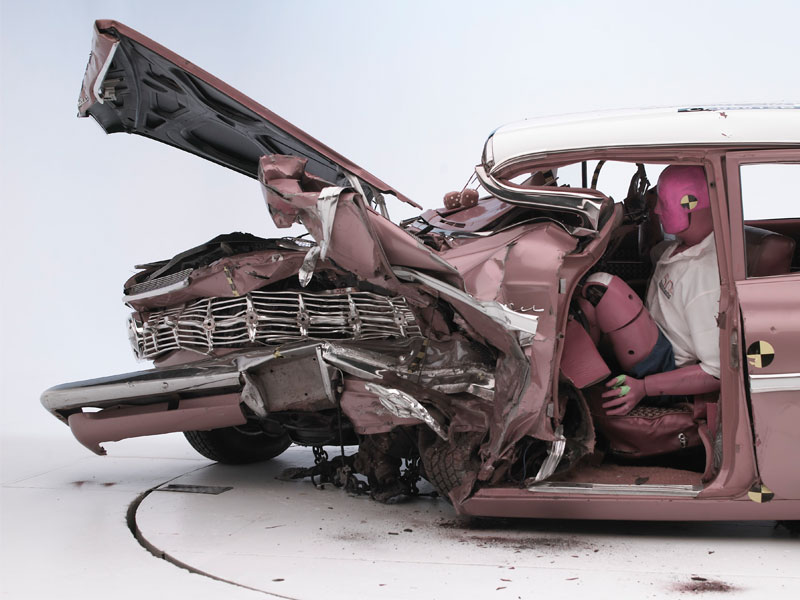
In part due to Ralph Nader’s Unsafe at any Speed, the late 1960s (1966) brought new federal regulations that all cars being manufactured were mandated to have – looks would no longer be more important than safety. GM was the most vocal about their dislike (basically every chapter in Nader’s book applied to all their cars). So GM tried to silence and discredit Nader (having him followed, tapping his phones, sending girls to him in the hope he would engage in illicit relationships with them, threating him, etc) and the money Nader got from suing GM for their actions allowed him to create the Center for Auto Safety. But Nader was right and most cars being manufactured were unsafe and they did skimp on safety for looks.
Now, safety was a priority. Seat belts (the lap belt, then later, shoulder belts) were required. White back-up lights were mandatory. Instrument panels had to be padded and no more protruding projections like long knobs and switches coming off of it (which could injure passengers during a crash). Less chrome and shiny metal on the dash, which lessened the chance of being blinded by reflected light. Hazard flashers and better braking systems. Moving the fuel tank so it was not too easily damaged and the gas set ablaze by a rear collision. A uniform P-R-N-D-L gear sequence for all cars (car manufacturers all had their own sequence [some not even having a P gear] and the 1961 and 1962 Cadillac had a P-N-D-L-R sequence, so if you were used to the last gear being low drive, you were going to be in for a shock when the Cadillac went into reverse and you slammed into the car behind you). Collapsible steering columns and headrests to help protect the driver from impalement and whiplash. And there have been much more since then. So customers began to replace their cars with the ones that had these new safely features and these older cars faded away.
So basically Nick would have to perform some incredible persuasion so they would let him use his Caddy for work. And Schanke was very lucky to have survived the car crash in Dark Knight considering the non-existent safety features on the Caddy. See an actual crash test between a 2002 Cadillac and a 1962 Cadillac here.
Up next: Detailed specifics about Nick’s Caddy, which would include such things as what color the car really is!


no subject
Date: August 18th, 2019 04:41 pm (UTC)no subject
Date: August 18th, 2019 04:49 pm (UTC)no subject
Date: August 19th, 2019 05:13 am (UTC)Apropos of car safety, at this time my parents had an Oldsmobile: red & white two-door hard-top. From 1955 or 1956, I think, bought secondhand when we moved to Canada. We kids called him "Elegant". (It was a "him" as far as we were concerned.)
It did not have seat belts; and, when these were being popularized, my father immediately went to a garage to have them installed. The mechanic was quite happy to put them on the front seats, but had difficulty grasping why my dad would want them in the back as well. After all, it was the kids who sat back there. (The assumption, I think, was that kids clamber around a lot in a car.)
Well, my dad insisted, of course. So then the guy said he could put in two seatbelts at the back, one each side, but not a third in the middle. My dad dug in his heels. ("I have three kids!")
In the end, the mechanic managed to contrive.
In these days of compulsory child seats, it's hard to imagine, isn't it?
no subject
Date: August 19th, 2019 11:52 pm (UTC)Yes, I just couldn't believe how much people resisted the various basic car safety things - like seatbelts - that we have today. My Dad remembers ads telling customers to not want the seatbelts because it would wrinkle their clothes. Unbelievable! Glad your Dad insisted on getting all the seatbelts installed!
no subject
Date: August 23rd, 2019 08:08 pm (UTC)no subject
Date: August 24th, 2019 12:50 am (UTC)Yeah - I was impressed by a lot of features that were on a car from the early 60's! It's hard to see a lot of the inside dash details on the car in the episodes, but there are a few quick glances. But the best info was what was provided when the Caddy was sold online years ago and it listed A/C, along with the cruise control, so I knew those were in there.
There is a lot of info in here, and hopefully it's not all boring! Sometimes I can get a bit carried away so thanks for going through the various sections!